Prevent, don't just record.
Discovery and runtime monitoring tell you what an agent did. Aegis decides — at the gateway, default-deny, with formal Cedar policy — what an agent can do.
Runtime control plane for autonomous AI agents
Aegis sits between your agents and the LLMs and tools they call. Workload identity, Cedar policy decisions, human approvals, and a tamper-evident audit chain — enforced at the protocol layer, not bolted on after the fact.
Self-hostable. OpenAI-compatible. Built on Cedar — the same policy language AWS uses for Bedrock AgentCore.
Why Aegis
Most "AI security" tools either watch agents from the side or lock you into a single cloud. Aegis is the in-line control plane that authorizes every model and tool call before it happens, with one consistent policy model across LLMs, MCP servers, and downstream agents.
Discovery and runtime monitoring tell you what an agent did. Aegis decides — at the gateway, default-deny, with formal Cedar policy — what an agent can do.
Issuing an agent a credential doesn't stop it from misusing one. Aegis ties workload identity to enforced policy, human approvals, and a replayable audit chain.
Microsoft governs Microsoft agents. AWS governs Bedrock agents. Aegis governs the agents you actually run — across OpenAI, Anthropic, your own models, and any MCP tool.
Where Aegis fits
Drop Aegis in front of your LLM and tool traffic. Every model call and MCP tool invocation passes the workload identity check, the Cedar policy decision, and optional human approval — and lands in the same audit chain. No SDK rewrites or per-agent code changes — you route traffic through Aegis and author the policy that governs it.
An actual policy
Aegis policies are written in Cedar — the same formally-verifiable policy language AWS uses inside Bedrock AgentCore. Product, platform, security, and compliance can all read the same rule. The policy analyzer can answer "can agent X take action Y on resource Z?" with a mathematically grounded yes or no.
// Allow the dispute agent to read case data...
permit(
  principal == Aegis::Agent::"DisputeBot-v1",
  action in [Aegis::Action::"mcp:tools:call"],
  resource in Aegis::ToolGroup::"dispute_context"
);

// ...but forbid reads of fraud investigation notes.
forbid(
  principal == Aegis::Agent::"DisputeBot-v1",
  action == Aegis::Action::"mcp:tools:call",
  resource == Aegis::Tool::"get_fraud_notes"
);
Why now
OpenAI, Anthropic, Google, Microsoft, AWS, and Block formalized MCP and A2A as the agent protocol standard. Agent traffic is consolidating onto two wire protocols Aegis already enforces.
High-risk AI deployments now need demonstrable runtime control, human oversight, and audit. Release-time review can't answer what an autonomous agent did in production.
Gartner projects 15% of daily business decisions will be made by agentic AI without human intervention. Every one of them needs an identity, a policy, and a record.
Inside the product
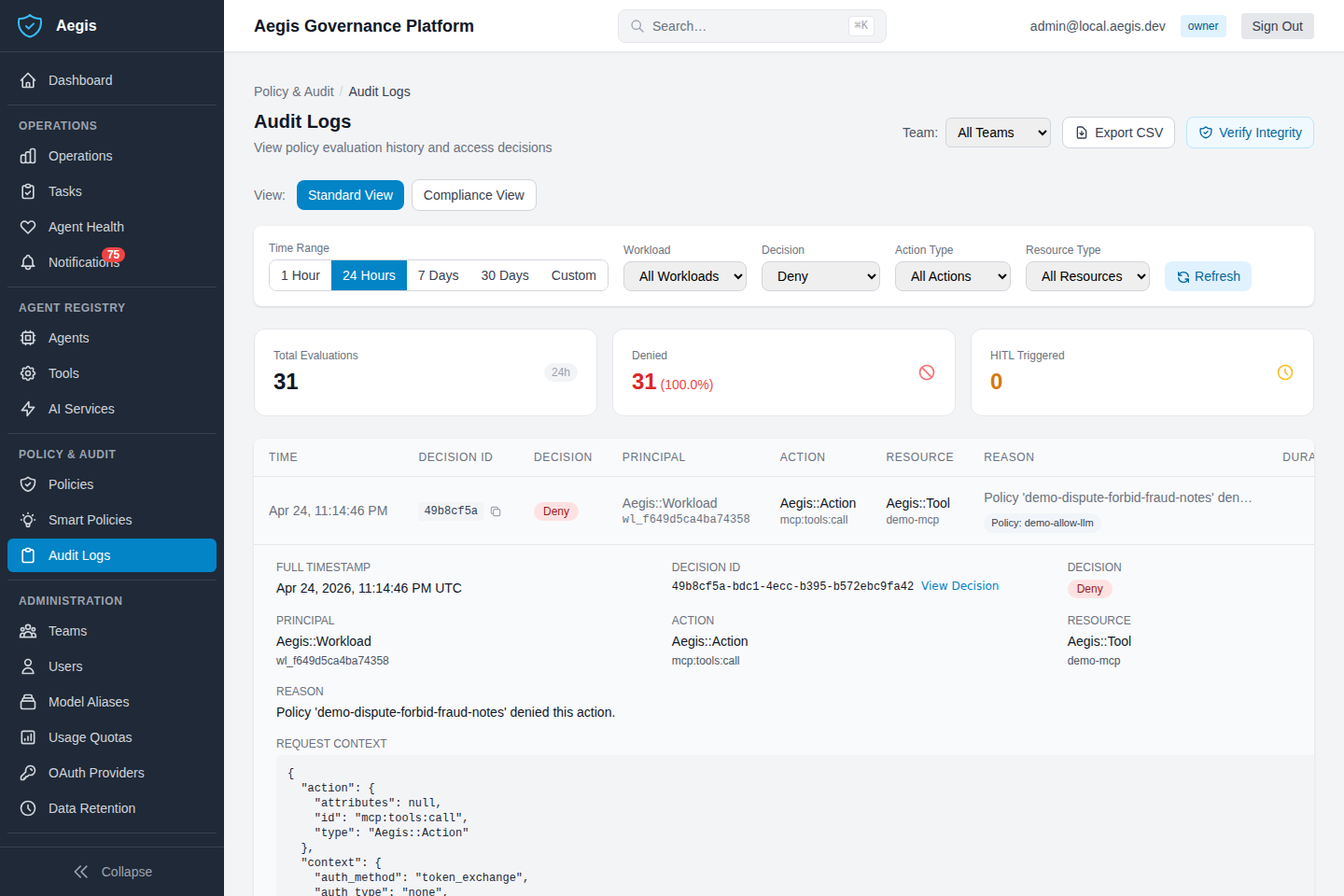
The audit log captures every policy decision — allow, deny, approval — with workload identity and full request context attached. Every record is HMAC-chained for tamper-evidence.
Every AI workflow has control points
Here is what those control points look like in practice — illustrated with a real dispute-remediation flow run against a live Aegis instance. DisputeBot-v1 starts with a workload identity, gets the context it needs, gets denied access to records it should not see, pauses on a credit action that needs a human, and lands every step in a tamper-evident audit chain. This is the current Aegis proof flow, not an aspirational diagram.
The same control pattern fits customer-support refunds healthcare prior authorisation insurance claim adjudication internal access & copilot tooling any agent that touches sensitive data or triggers operational change
The Aegis IDP issues a workload JWT for DisputeBot-v1. Owner, scope, and the dispute workflow are bound to the credential before any tool call.
Case lookup, customer history, and transaction details pass the Cedar policy check for this workflow and reach the worker.
The deny policy demo-dispute-forbid-fraud-notes blocks the read. The denied attempt is
captured with full request context.
The proposed $254.97 credit crosses a threshold. Aegis pauses execution and routes the action to a card-ops operator with policy and context attached.
Identity, allowed reads, denied reads, approval decision, approver role, and final outcome are preserved in the HMAC-chained audit log for later inspection.
What teams can evaluate
Aegis sits as a control layer in front of model and tool access. Adopting it for a workflow involves workload registration, gateway routing, Cedar policy authoring, and reviewer setup for that workflow — not a zero-config install. The surfaces below are what a pilot evaluates around.
The control surface is designed to run inside the customer environment so sensitive workflow data stays in boundary.
Place policy in front of model and tool access without rebuilding every application workflow that needs it.
Use explicit, declarative rules that product, platform, risk, and compliance stakeholders can read together.
Send actions to the right reviewer when policy thresholds, data sensitivity, or business risk require it.
Keep an HMAC-chained record of identity, access, policy decisions, approvals, denials, and outcomes.
Adopt the controls around one AI agent first. Evaluate the model, then decide where the same pattern should apply next.
Where Aegis is today
The first proof point is governed dispute remediation: a real AI agent, a real Cedar deny policy on sensitive context, real human approval routing on a credit action, and a real HMAC-chained audit log across the full sequence. Concrete enough to evaluate against your own workflow controls.
Where it extends
The same primitives — identity, policy, approval, audit — are designed to apply across additional regulated agent workflows. Pilot one, and the same controls become reusable for the next, instead of a new bespoke review process each time.
Aegis is being evaluated through structured pilot conversations with regulated product, platform, and control teams. Treat the public site as an honest read of what is shipped today, not a claim of current customer deployments.
Design partner fit
The best pilot conversations are with regulated product, platform, operations, or control teams that already know which AI agent they want to deploy, but need a stronger answer for policy enforcement, human review, and audit before it reaches production.
Built by someone who has lived the problem
Founder & CEO, Aegis
Previously at JPMorgan Chase, working in software engineering and security controls inside regulated banking systems. I have seen how compliance review operates at scale — and exactly how it breaks down when AI agents start crossing data boundaries and triggering operational changes.
Aegis is the platform I would have wanted: runtime identity, policy, and audit that gives product teams a deployment path and gives control functions a defensible answer.
Stay in the loop
Send us a note with what you're trying to govern. We'll reach out when Aegis is relevant to your deployment timeline — no sales sequence, just useful updates.
Pilot conversation
Bring the workflow, the systems it touches, the actions that require approval, and the audit questions your team has to answer. Aegis can be evaluated around that concrete operating problem in a focused pilot conversation.